Beta-Glucan in Aquaculture: Strengthening Immunity Naturally

In the world of aquaculture, disease prevention and growth efficiency are constant challenges. Beta-glucans — natural polysaccharides found in the cell walls of yeast (Saccharomyces cerevisiae), fungi, cereals, and algae — have emerged as one of the most effective natural immunostimulants for fish and shrimp.
By priming the innate immune system, beta-glucans help aquatic species fight bacterial, viral, and parasitic infections without relying on antibiotics, making aquaculture more sustainable and residue-free.
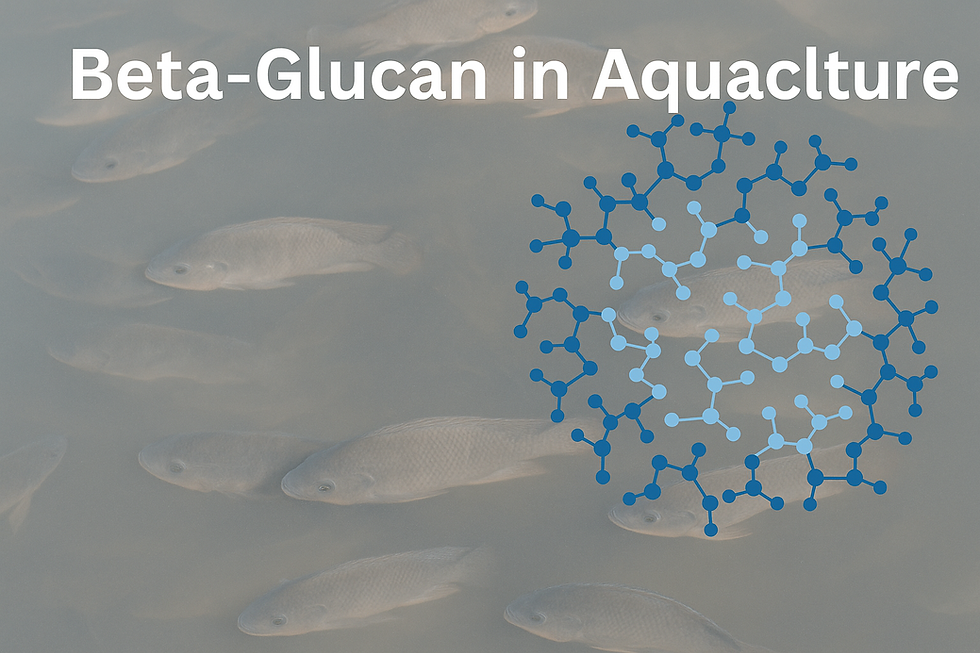
Beta-Glucans in Aquaculture - Working Principle
Beta-glucans activate the non-specific (innate) immune system. When consumed, they bind to immune receptors such as Dectin-1 and Toll-like receptors (TLRs) on macrophages, neutrophils, and other immune cells. This interaction triggers a cascade of immune responses that include:
Enhanced Phagocytosis: Improved engulfing and destruction of pathogens.
Cytokine Production: Regulation of immune signaling molecules that coordinate defense mechanisms.
Complement Activation: Faster recognition and neutralization of pathogens.
In essence, beta-glucans “prime” the immune system to react more efficiently when an infection occurs, leading to stronger and faster immune responses.
Benefits of Beta-Glucans in Aquaculture
1. Enhanced Disease Resistance
Beta-glucans improve resistance to bacterial, viral, and parasitic infections such as Aeromonas hydrophila, Vibrio species, and White Spot Syndrome Virus.
2. Reduced Antibiotic Use
By naturally strengthening immunity, beta-glucans lower disease incidence and reduce the need for antibiotics — a critical step toward sustainable, residue-free aquaculture.
3. Improved Growth and Feed Efficiency
Healthier fish and shrimp exhibit better feed conversion ratios (FCR), higher survival rates, and improved overall growth performance.
4. Better Stress Tolerance
Beta-glucans improve resilience to stressors such as handling, transport, salinity changes, and high stocking densities — key factors that often suppress immunity in intensive farming conditions.
Applications in Aquaculture
Fish: Commonly used in feeds for tilapia, catfish, carp, and salmonids at inclusion rates of 0.1–0.5%.
Shrimp and Prawns: Added at 0.2–1.0% during nursery and grow-out stages to boost resistance against Vibrio and viral infections.
Larval and Early Stages: Promotes immune development and increases post-larval survival rates.
Beta-glucans work synergistically with probiotics, prebiotics, nucleotides, vitamins, and trace minerals. Together, these ingredients promote both gut health and immune efficiency. Functional feeds combining beta-glucans with these bioactives have shown significant improvements in survival and performance under intensive aquaculture conditions.
Beta-glucan stands out as a natural, effective, and sustainable immunostimulant for aquaculture. Its unique ability to activate innate immunity, reduce antibiotic dependency, and enhance stress tolerance makes it a cornerstone of next-generation functional feeds for fish and shrimp.
At Kshamatva, we offer high-quality, water-soluble beta-glucan tailored for aquaculture applications.
Our beta-glucan supports better immunity, healthier growth, and sustainable farming — empowering aquaculture systems that are antibiotic-free and future-ready.


Comments